
In late 2024, Chinese artist Lulu Li made headlines for something that would have been impossible just three years earlier: she designed an entire capsule collection for Moncler without ever stitching a single seam. Using AI tools like Midjourney and Runway, Li generated fantastical puffer-jacket silhouettes—exaggerated volumes in soft ivory and glossy black—that Moncler’s technical team then translated into real, wearable garments. The collection sold out globally, and Li told Vogue she still doesn’t formally know how to make clothes.
Her story isn’t an outlier. It’s a preview.
The global fashion technology market hit an estimated $253.9 billion in 2025 and is projected to reach $345.4 billion by 2030, according to Grand View Research. From the sketchpad to the sales floor, technology in fashion is rewriting every rule: how clothes are imagined, manufactured, sold, and even worn. Whether you’re a small independent designer testing your first smart-fabric prototype, an e-commerce manager wrestling with return rates, or a consumer who simply wants jeans that actually fit when they arrive at your door, the implications are personal—and they’re happening now.
This article breaks down the major tech shifts transforming modern fashion, with real-world examples, business implications, and practical takeaways you can act on today.
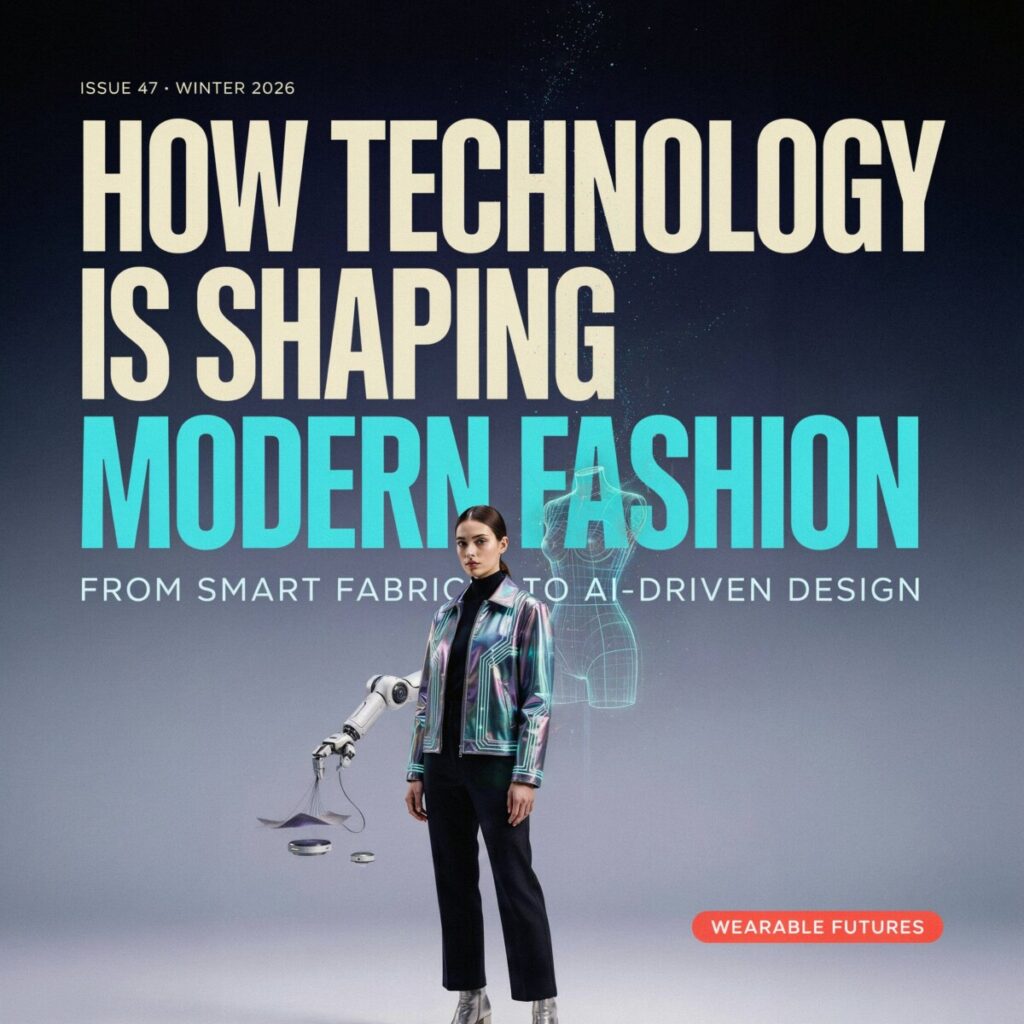
Design and Creativity: AI as the New Atelier
For decades, fashion design was a stubbornly analog craft: mood boards pinned to cork, watercolor sketches, endless sample iterations shipped overseas. That pipeline is collapsing. AI fashion design tools—powered by generative adversarial networks (GANs), which pit two neural networks against each other to produce increasingly refined outputs—are allowing designers to explore thousands of aesthetic variations in minutes rather than months.
Design automation software can now generate repeating prints optimized for minimal fabric waste. Predictive analytics scan social media, runway shows, and retail data to forecast trends with startling accuracy, helping brands move from gut-feel decisions to evidence-based ones.
Perhaps the most ambitious example comes from Norma Kamali, the legendary New York designer. Through MIT Professional Education’s applied AI program, Kamali built a closed-loop AI model trained exclusively on her own 57-year archive—a sort of digital extension of her creative brain. When she prompted the model with variations of her iconic studded silhouettes, the AI hallucinated forms she never would have sketched herself. “Some of the best editorial fashion is absurd,” Kamali told MIT News. “AI-generated anomalies created entirely new forms of art.” The resulting AI-designed pieces now live alongside her traditional collections on her website.
Elsewhere, Golden Goose partnered with Google’s Gemini AI to let customers co-create custom sneakers in 44 stores worldwide. Shoppers describe a memory, mood, or symbol; Gemini translates it into a visual draft projected onto a digital sneaker in real time; Italian artisans then hand-paint the final design. It’s mass customization at luxury scale—personal, emotional, and powered by an algorithm.
For independent designers, these tools are increasingly accessible. Free or low-cost platforms like Canva’s Magic Studio, Adobe Firefly, and open-source Stable Diffusion models can generate mood boards, print variations, and even virtual runway looks without a six-figure budget. The new creative skill isn’t drawing a perfect hemline—it’s writing a prompt that produces one.
Production and Manufacturing: 3D Printing, On-Demand, and Automation
If design is where fashion dreams, manufacturing is where it either scales or breaks. The traditional model—ordering thousands of units months in advance, warehousing them, then discounting whatever doesn’t sell—is staggering in its waste. The industry produces roughly 100 billion garments a year, and an estimated 30% never sell. Technology is starting to fix that math.
3D printing clothing and accessories has moved from gimmick to genuine production tool. Designers use it for rapid prototyping—iterating on a handbag clasp or a shoe heel in hours instead of weeks—and for producing limited-edition components that would be prohibitively expensive to mold traditionally. Iris van Herpen has been 3D-printing couture for over a decade, but the technology is now trickling down to smaller studios: desktop resin printers under $1,000 can produce jewelry, buttons, and embellishments with professional quality.
On-demand manufacturing is the bigger structural shift. Companies like Unspun in San Francisco use 3D body scanning and robotic weaving to produce jeans only after a customer has ordered them—zero inventory, near-zero waste. Cut-and-sew on-demand platforms allow small labels to list products without committing to minimum order quantities, dramatically lowering the barrier to entry. A solo designer in Brooklyn can now sell a garment globally and have it produced in a factory in Los Angeles only once a purchase clears.
Robotic automation in factories—automated cutting machines, sewing robots like SoftWear Automation’s Sewbot—addresses a harder problem: the labor-intensive, low-margin reality of garment assembly. While full automation of complex garments is still years away for most categories, partial automation is already reducing prototyping time and enabling reshoring of some production to the US, with all the supply-chain resilience that implies.
The business case is clear: for small brands, on-demand models convert fixed inventory risk into variable cost. For large retailers, even a 10% reduction in overstock can translate to tens of millions of dollars recovered.
Materials Innovation: Smart Fabrics and Wearable Tech
The most intimate frontier of fashion tech is the fabric itself. Smart fabrics—textiles embedded with sensors, conductive threads, or responsive materials—are turning passive clothing into an interface. The US smart fabrics market alone is expected to grow from $2.74 billion in 2025 to roughly $30 billion by 2034, according to Precedence Research, fueled by demand for fitness tracking, health monitoring, and adaptive comfort.
Everyday examples are already on the market. Heated jackets with app-controlled temperature zones. Moisture-wicking base layers that adjust their ventilation based on sweat levels. Sports bras with embedded heart-rate sensors that eliminate the need for a separate chest strap. Lululemon’s recent “Mirror” integration and Athos’s biosensor-lined training gear represent the performance end; at the luxury end, brands are experimenting with fabrics that change color or opacity in response to light or body heat.
Fabric sensors are the quiet revolution. Conductive yarns woven directly into a garment can measure heart rate, muscle activation, posture, and even hydration—data streams that previously required separate wearable devices. Wearable technology is no longer synonymous with a wristband; it’s dissolving into the clothes themselves.
The sustainability angle is equally compelling. Biofabricated materials—lab-grown leather from companies like VitroLabs, spider-silk proteins from Bolt Threads, and mycelium-based alternatives like Mylo—are reducing reliance on animal hides and petroleum-based synthetics. Recycled fibers enhanced with nanotechnology now offer durability and performance that rival virgin materials. Textile innovation, in other words, is solving both the “what do we wear” and “what do we do to the planet” questions simultaneously.
Privacy concerns are real and often under-discussed. A garment that tracks your biometrics is also generating intimate health data. US consumers should watch how brands handle that data—and whether they opt in explicitly or bury consent in a terms-of-service wall.
Retail and Consumer Experience: AR, Virtual Try-On, and Personalization
Here’s a painful stat: online apparel return rates in the US hover between 30% and 40%. The vast majority are fit- and appearance-related—the customer simply couldn’t tell from a flat product photo how the item would look or feel. It’s an expensive problem, and it’s being solved by virtual try-on and augmented reality fashion tools at an accelerating pace.
The virtual try-on market reached $15.18 billion in 2025 and is projected to hit $48.1 billion by 2030 (Grand View Research). The ROI is tangible: Shopify’s 2025 commerce data found that product pages with try-on functionality increased conversion rates by 20–35% and reduced returns by 25–40%. A 2026 DRESSX study of over one million luxury shoppers found that virtual try-on users were three times more likely to add items to cart and viewed seven times as many product listings as non-users.
Nike Fit uses smartphone cameras to scan a customer’s foot in 3D and recommend the correct size—a problem that historically drove massive return volumes for sneakers. Warby Parker pioneered AR face mapping for eyewear, letting customers cycle through frames on their own face before ordering. Major retailers from Zara to Gucci have integrated similar tools directly into their apps. Fashion e-commerce personalization engines, meanwhile, use size-recommendation AI and fit prediction models trained on millions of purchase-and-return data points to guide customers to their best size across brands—the kind of intelligence a size recommendation engine can deliver at scale in ways a static size chart never could.
For retailers, the case is now essentially closed: virtual try-on is not a luxury feature but a table-stakes investment. The gap, remarkably, is adoption. Despite proven ROI, only about 1% of general e-commerce stores and roughly a third of the top 100 fashion retailers have deployed it. The early-mover window is still wide open.
Sustainability and Supply Chain Transparency
Behind every garment is a supply chain most consumers will never see—and that opacity has long been the industry’s sustainability blind spot. Fashion sustainability tech is changing that. Blockchain-based supply chain traceability now lets brands prove, not just claim, where materials came from and under what conditions they were produced.
In early 2025, Victoria’s Secret & Co. launched its first digital product passport (DPP)—a QR code on select bras that reveals the full material journey, including cotton sourced directly from four family farms in Alabama. Later that year, Another Tomorrow, a New York-based B Corp luxury label, joined the Aura Blockchain Consortium (co-founded by LVMH and Prada) to deploy blockchain-backed DPPs across its entire Winter/Spring 2026 collection. Scan the label, and you see sourcing, production data, environmental impact, and an authenticated resale listing—all on an immutable ledger.
The EU is moving to mandate DPPs for textiles by 2027, and US brands selling globally are preparing now. Zegna has implemented comprehensive fiber-to-garment traceability with TextileGenesis, using a proprietary “Fibrecoin” token system that tracks certified fibers across more than 400 production steps. On the operational side, IoT fashion sensors in warehouses and shipping containers monitor inventory in real time, helping brands match production more closely to demand and reduce the overproduction that generates so much of fashion’s carbon footprint.
Tech is also enabling circular fashion at scale: resale platforms like The RealReal and ThredUp, rental services, and automated take-back programs all rely on digital infrastructure to verify authenticity, manage logistics, and close the loop on garments that would otherwise go to landfill.
Challenges and Ethical Considerations
The optimism is warranted, but so is scrutiny. Several concerns deserve attention.
Data privacy is foremost. Smart garments generate biometric and behavioral data—heart rate, movement patterns, location. Virtual try-on tools process facial and body geometry. US consumers currently lack a comprehensive federal data-privacy law, so protections vary by state and by brand. Ethical fashion technology means more than eco-friendly materials; it includes how data is collected, stored, and monetized.
Job displacement in manufacturing is real. Automation threatens low-wage garment workers in the US and globally. The transition must be managed with retraining programs and policies that account for displaced labor, or the industry risks solving a waste problem by creating an employment crisis.
Techno-greenwashing is a growing concern. A brand adopting a single “sustainable” material or publishing a glossy traceability dashboard while running fundamentally unsustainable volumes is using technology as cover, not as a solution.
Finally, accessibility. Smart garments, AR-fitted luxury, and custom 3D-printed accessories skew expensive. If technology’s benefits remain gated to premium tiers, the industry will widen, not narrow, the gap between what most consumers can access and what the future of fashion promises.
Future Outlook and Practical Takeaways
The next three to five years will bring AI fashion design moving from creative exploration to production-grade pattern making, virtual fashion becoming a mainstream channel for both try-on and digital-only garments (especially among Gen Z), and smart textiles scaling from niche performance wear into everyday basics as production costs fall. Regulatory pressure—especially EU DPP mandates—will force global traceability adoption, and the US market will follow suit.
If you’re a designer or small brand owner:
- Experiment with AI design tools now; the learning curve is gentle and the creative upside is large.
- Investigate on-demand manufacturing partners to reduce inventory risk—minimums are lower than you think.
- Build traceability into your supply chain early; it will soon be a competitive requirement, not a differentiator.
If you’re an e-commerce manager or retailer:
- Virtual try-on is the single highest-ROI tech investment you can make this year—prioritize it.
- Deploy a size recommendation engine to reduce returns; even a 5-point reduction in return rate has outsized margin impact.
- Personalization engines that learn from browsing behavior drive AOV and repeat purchases.
If you’re a consumer:
- Be curious but deliberate about the data you share. Smart garments and try-on apps collect sensitive biometric and body data—read the privacy policy.
- Seek out brands with verifiable traceability (QR-linked DPPs, blockchain records) over brands with vague “sustainable” marketing.
- Embrace resale and rental platforms enabled by tech authentication—your closet can be circular without being expensive.
The future of fashion won’t be chosen by technologists or designers alone. It’ll be shaped by the everyday decisions of the people who make, sell, and wear clothes—and by who is willing to look past the hype and ask what the technology actually does, for whom, and at what cost.
“The question is no longer whether technology belongs in fashion. It’s whether fashion can afford to ignore it.”
What’s the most interesting piece of fashion tech you’ve encountered recently—a smart garment that surprised you, a virtual try-on that actually worked, a brand whose transparency impressed you? Drop it in the comments below, or share this article with a fellow fashion-techie who needs to see what’s coming.
